Despite challenges she faces, 10-year -old Priscilla Black, a Standard One learner at Chilusa Primary school in Balaka, brightens up the corridors of her primary school with her infectious smile.
Born with cerebral palsy, Priscilla relies on her wheelchair to navigate the uneven terrain and the outdated infrastructure of her school.
However, the lack of accessible toilets and accessible pathways makes everyday tasks a daunting ordeal. With the help of her dedicated teacher and supportive classmates, Priscilla perseveres, refusing to let her physical disability define her education journey.
Her determination and resilience inspires all those around her, serving as an emotional reminder of the importance of inclusivity and accessibility in education.
Her day begins before dawn, as she embarks on a lengthy journey to school from her rural village which is several kilometres away.
Priscilla’s mother and grandmother take turns in escorting her to school, navigating treacherous terrain daily.
As they escort her to school, they have to deal with dusty potholed roads and dilapidated bridges.
Upon arrival, they are met with daunting obstacles of stairs, narrow corridors and uneven flooring, which makes it difficult for Priscilla to access her classrooms, the library, and even the restrooms.
The absence of adapted facilities forces her to rely on her peers to carry her up and down, a humiliating experience that erodes her confidence and independence.
Due to her disability, she is sometimes forced to stay at home for weeks without attending classes which mostly affects her performance.
“During rainy season, my parents are occupied with farming; hence, there is no one to push my wheelchair to school and I mostly miss classes. At 10 years old, my friends are in upper primary classes but here I am in primary school and Standard One,” she laments.
“This disability robes my right to education.”
The head teacher at the school, Hector Jalasi, says learners with such disabilities often drop out of school due to such challenges they encounter.
“Since 2020 we have had eight learners with disabilities. Unfortunately, seven dropped out due to lack of specialised teachers to properly groom them. Now we only have one learner with a physical disability,” he says.
Jalasi highlights the need to match the school’s infrastructures with the need for physically-challenged learners.
“Some girls who are physically challenged had difficulties accessing washrooms and toilets during their monthly periods, as such, during such times of the month they used to absent themselves from classes to avoid troubling their classmates to move them around,”, he says.
This is a clear indication that students with disabilities are being robbed off their right to education.
Jerad Nyamazafa, 17, from Mkando in Mulanje District, says learning with a physical disability is difficult.
Jerad says infrastructure is often not favourable for persons with disabilities to navigate school premises with ease.
“Due to long distance and poor infrastructure at my school, it forced me to drop out in Standard Five. The long distances made me skip classes which eventually led me to outgrow my class,” he says.
“As a person with disability, this will perpetuate dependency syndrome which leads to abuse.”
For Evelyn Kujingo, 24, from Area 36 in the outskirts of Lilongwe City, the story is no different. She still recalls the struggles she encountered in the course of scvhool.
Being physically challenged and confined to a wheelchair since birth, she was lucky to attend a special primary and secondary school for children with disabilities (SOS) in Lilongwe.
“My teachers and classmates helped me to navigate the school premises with no problems and the school has infrastructure that accommodated my wheelchair,” she says.
The reality sunk in the moment she was selected to the University of Malawi, formerly known as Chancellor College, to study for a bachelor’s degree in humanities.
“The struggle began when I wanted to use the library and the toilet. My wheelchair could not use the steps up the library. This made my studies at the university very difficult,” she recalls.
She hopes schools should be constructed to accommodate students with disabilities.
“Government in its policies should try to consider building schools for special students to learn without difficulties, “she says.
Kujingo was quick to say inclusion should not only end in schools, but it should rather should be advocated in employment as well.
“Persons with disabilities are denied their rights to employment when they finish school, which hinders their independence,” she says.
As Pr isci l la navigates the complexities of primary school, her story serves as a stark reminder of the systemic barriers that hinder inclusion education. Despite her unwavering spirit, the lack of accessibility and support threatens to derail her academic aspirations. Yet, Black’s determination inspires a growing movement within her school community, as teachers, parents, and policymakers begin to advocate for critical infrastructure upgrades and disability-friendly reforms.
As the wheels of change slowly turn, Priscilla’s courage and resilience illuminate a brighter future; one where every student, regardless of ability, can access quality education and unlock their full potential.
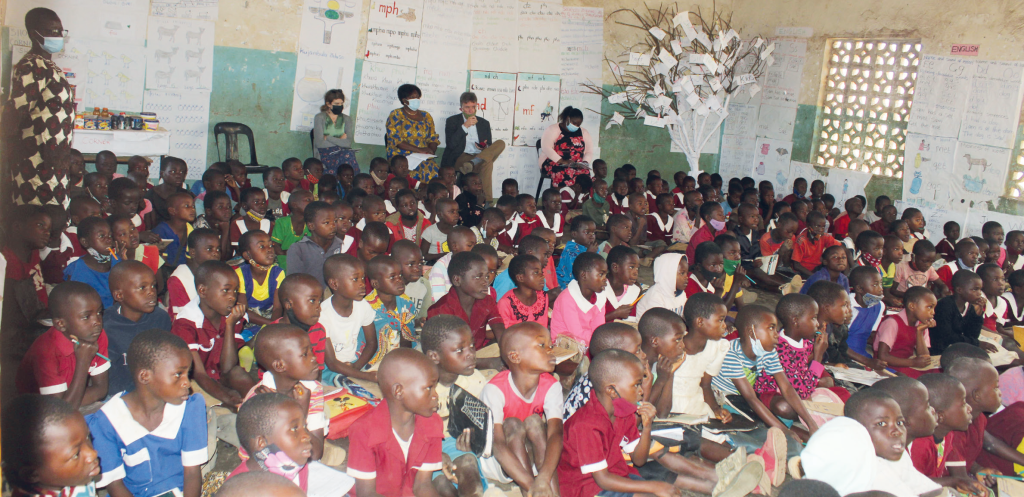
Standard 2 pupils learning new mathematics skills. I Carol Mkandawire.
Priscilla Black on her wheelchair